A pet gut health supplement can look simple from the outside, but many brand owners discover problems only after sampling, packaging, or stability questions begin. If the formula, dosage form, claims, and supplier process do not match, the launch can slow down. The better solution is to treat private labeling as product development, not just relabeling.
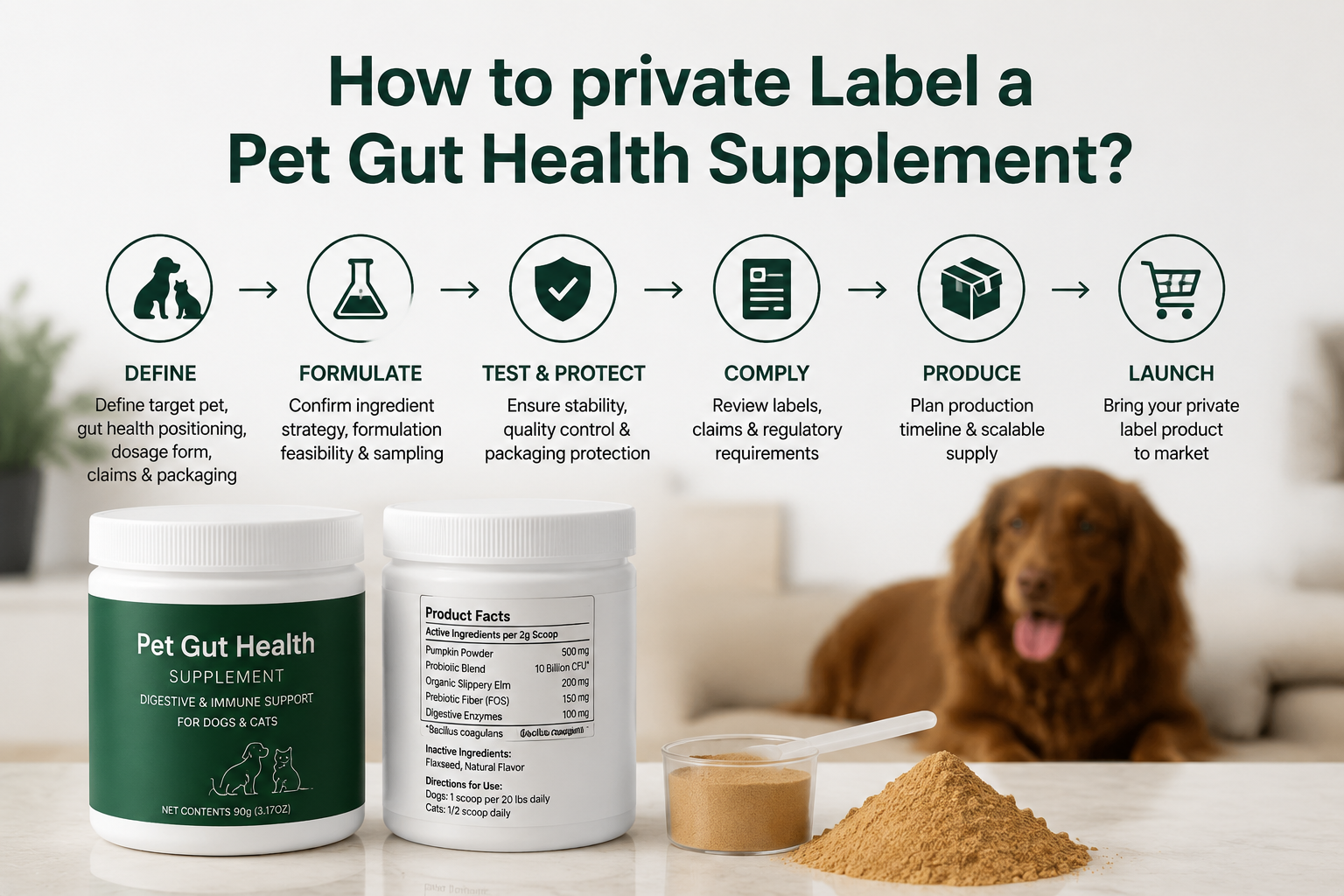
To private label a pet gut health supplement, I would first define the target pet, gut health positioning, dosage form, ingredient strategy, packaging needs, and market claims. Then I would work with a qualified manufacturer to confirm formulation feasibility, sampling, stability protection, quality control, label review, production timeline, and scalable supply before launch.
Many brand owners first ask me about ingredients, CFU counts, or how fast they can launch. Those questions matter. However, in real project discussions, the bigger issues are usually stability, dosage form, packaging protection, owner usage habits, and launch feasibility.
How should I define the right pet gut health supplement before private labeling?
Many brands start with the question, “Can I private label this quickly?” That question feels practical, but it can lead to a generic product. A weak concept creates pressure later. The product may look similar to competitors, or the formula may not fit the intended pet, format, or claim direction.
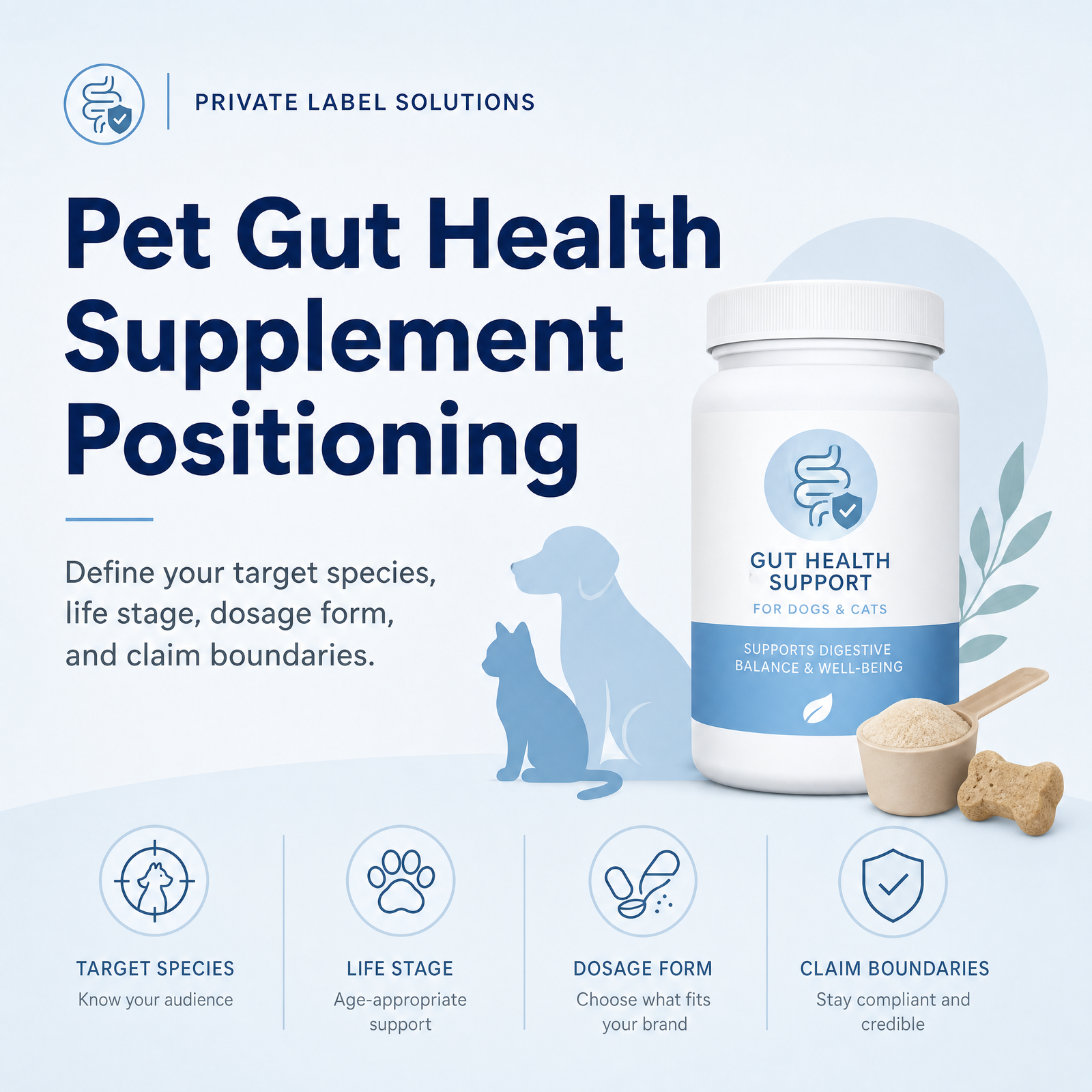
The better starting point is this: What type of pet gut health supplement can my brand reliably launch, differentiate, and keep consistent at scale? I would define the target species, life stage, dosage form, benefit positioning, ingredient logic, packaging format, and claim boundaries before asking for samples or pricing.
Start with the target pet and real use case
When I speak with brand owners, I often hear a broad idea like, “We want a digestive supplement for pets.” I understand why. Digestive health is a large category[^1], and many pet owners already understand terms like probiotics, prebiotics, and gut support.
However, a strong pet gut health supplement needs a sharper product brief. I would usually ask questions like:
- Is the product for dogs, cats, or multiple species?
- Is the target pet a puppy, kitten, adult, senior, or all life stages?
- Is the product for daily wellness support or occasional digestive balance?
- Does the brand want a soft chew, powder, tablet, gel, or paste?
- Does the product need to fit e-commerce shipping, retail shelves, or veterinary channels?
- Which market will the product enter first?
These questions are not just marketing details. They affect the formula, serving size, ingredient level, flavor system, packaging, and label language.
Positioning should come before ingredient selection
A common mistake is to start with a trendy ingredient list. I have seen brands ask for “probiotics, pumpkin, enzymes, and postbiotics” before deciding what the product should actually stand for.
That approach can create several problems:
-
The formula becomes crowded.
Too many active ingredients can increase cost, complicate flavor, and create stability concerns. -
The positioning becomes vague.
If the product claims everything, the consumer may not understand the core reason to buy. -
The dosage form may not support the ingredient plan.
Some probiotic strains, enzymes, or moisture-sensitive ingredients may need careful processing and packaging. -
The label may become risky.
Gut health claims should be reviewed for the target market. One phrase may be acceptable in one region and problematic in another.
A practical positioning table
| Positioning direction | Common product logic | Possible dosage forms | Key launch questions |
|---|---|---|---|
| Daily digestive support | Probiotics, prebiotics, fiber, enzymes | Soft chews, powders, tablets | Can the formula stay stable through shelf life? |
| Sensitive stomach support | Gentle fiber, selected probiotics, soothing nutrition concepts | Powders, chews, gels | How should claims be worded without treatment language? |
| Stool quality support | Fiber blend, prebiotics, digestive enzymes | Powders, chews | Does the serving size allow meaningful inclusion levels? |
| Cat digestive wellness | Palatability-focused formula, lower serving size | Powders, gels, pastes | Will cats accept the taste and texture? |
| Senior pet gut support | Digestive support plus broader wellness positioning | Soft chews, tablets, powders | Does the texture fit older pets? |
In my experience, a clear product brief reduces revision cycles. It also helps the manufacturer give better advice. Instead of only asking, “What is the MOQ?” the brand can ask, “Can this formula direction work in this format, with this packaging, for this market?”
That is a much stronger way to develop a private label product.
Which dosage form works best for a pet gut health supplement?
Choosing the wrong format can make a good formula difficult to sell. Pet owners may dislike messy dosing. Pets may reject the taste. Moisture may affect sensitive ingredients. Production may become more complex than expected, especially when the brand wants probiotics, enzymes, or multiple functional ingredients in one product.
The best dosage form for a pet gut health supplement depends on palatability, dose flexibility, moisture sensitivity, texture, packaging needs, production complexity, and owner habits. Soft chews are popular for convenience, powders are flexible for dosing, tablets are compact, and gels or pastes can work well for targeted feeding situations.[^2]
Compare the practical launch variables
I do not think any dosage form is automatically “best.” Each one creates tradeoffs. I usually help brand owners compare the format against the target customer and the intended formula.
| Dosage form | Strengths | Watch points | Good fit for |
|---|---|---|---|
| Soft chews | High pet owner acceptance, treat-like experience, strong retail appeal | Moisture control, texture stability, palatability system, heat/process sensitivity | Dog digestive chews, daily gut support products |
| Powders | Flexible dosing, easy to mix with food, suitable for multi-ingredient blends | Scoop accuracy, dusting, flavor acceptance, moisture protection | Dogs and cats, probiotic powder, fiber blends |
| Chewable tablets | Compact, stable, efficient packaging, clear serving count | Hardness, breakability, palatability, pet acceptance | Cost-controlled formulas, retail packs, daily use |
| Gels and pastes | Easy administration for some pets, useful for cats, strong targeted-use feel | Tube filling, texture control, flavor masking, preservative system | Cat gut support, hairball-plus-digestive concepts, occasional use |
Soft chews: strong market appeal, but not always simple
Soft chews are very popular in the pet supplement market because they feel like treats. Many dog owners prefer them because they are easy to give and do not require mixing. A soft chew pet gut health supplement can also create strong shelf appeal with a pouch, jar, or canister.
However, soft chews require careful formulation. Moisture level, water activity, texture, and heat exposure can all matter.[^3] If the formula includes probiotics, the brand should ask how the manufacturer manages processing conditions and packaging protection. A high CFU target on paper does not help if the final product cannot maintain the intended level through shelf life.[^4]
Soft chews can work well when:
- The brand targets dog owners who prefer treat-like supplements.
- The product needs strong flavor and easy daily feeding.
- The formula has been developed with texture and stability in mind.
- The packaging protects against moisture and oxygen exposure.
Powders: flexible, efficient, and often underestimated
Powders can be a very practical choice for gut health products. They allow flexible dosing by pet weight. They also make it easier to include ingredients like fiber, prebiotics, enzymes, and selected probiotics without forcing everything into a chew matrix.
However, powders depend heavily on owner behavior. Some pet owners love scooping powder onto food. Others find it inconvenient. Cats may reject strong odors. Dogs may tolerate powder better when it is blended with wet food.
A powder format can be strong when:
- The brand wants a probiotic powder for dogs and cats.
- The serving size needs to support fiber or prebiotic inclusion.
- The brand sells through e-commerce and wants lighter shipping.
- The formula needs lower moisture exposure than a soft chew.
For packaging, powder products often need jars, tubs, sachets, or stick packs. Sachets can improve dose accuracy and moisture protection, but they may increase packaging cost. Jars are familiar and cost-effective, but the product is exposed every time the consumer opens the container.
Tablets, gels, and pastes: useful when the concept fits
Chewable tablets can be compact and cost-efficient. They can also support clear serving instructions. Yet palatability can be harder than with soft chews. If the tablet is too hard or not tasty enough, repeat purchase may suffer.
Gels and pastes can be useful for cats or targeted feeding occasions. They can create a premium feel when packed in tubes or syringes. Still, they require attention to viscosity, separation, flavor masking, and packaging compatibility.
The format should match the use case. I would not choose a dosage form only because it is trending. I would choose it because the pet, owner, formula, and supply chain all support it.
How should I evaluate probiotics and ingredients in a pet gut health supplement?
Many brand owners ask for the highest CFU count they can print on the label. I understand the instinct. A larger number looks impressive. But CFU count alone can be misleading if the strain is not suitable, the formula is unstable, or the packaging does not protect the finished product.
A good pet gut health supplement should evaluate probiotics and digestive ingredients by strain suitability, intended use, inclusion level, shelf-life survival, manufacturing conditions, packaging protection, and claim strategy. Brands should not chase only the biggest CFU number. They should ask whether the ingredient plan can remain consistent from production to consumer use.
Why CFU count alone is not enough
CFU means colony-forming units.[^5] It is commonly used for probiotic products. Many buyers ask questions like, “Can we make 5 billion CFU?” or “Can we make 10 billion CFU?”
Those are reasonable questions. However, they are incomplete.
A brand should also ask:
- Which probiotic strain is being used?
- Is the strain suitable for the target species and product concept?
- Is the CFU level measured at production or through shelf life?
- What processing temperature or pressure will the ingredient experience?
- What is the expected survival in the selected dosage form?
- How will packaging protect the product from moisture, oxygen, and heat?
- What testing or documentation can support quality expectations?
In project discussions, I often remind customers that a probiotic pet supplement is not only a label number. It is a stability challenge, a formulation challenge, and a packaging challenge.
Ingredient selection should follow product logic
A strong formula usually has a clear reason for each ingredient. For a pet digestive health supplement, the ingredient strategy may include:
- Probiotics to support gut microbiome balance.[^6]
- Prebiotics to serve as a food source for beneficial bacteria.[^7]
- Digestive enzymes to support nutrient breakdown.[^8]
- Fiber sources to support stool quality and digestive regularity.[^9]
- Functional botanicals or nutrition ingredients with market-appropriate positioning.
The key is not to add everything. The key is to build a formula that fits the serving size, dosage form, taste, cost target, and claim direction.
For example, a dog soft chew may not have unlimited room for high fiber inclusion because the chew must still taste good and hold its shape. A powder may allow more room for fiber, but it must mix well and avoid strong odors. A gel or paste may need different considerations for texture and preservation.
Stability depends on the full system
Ingredient stability is not only an ingredient issue. It depends on the entire product system.
A probiotic formula can only be as reliable as the manufacturing process, packaging protection, storage expectations, and quality controls behind it.
Here are common stability factors I would review:
| Stability factor | Why it matters | Questions to ask |
|---|---|---|
| Moisture | Probiotics and enzymes may be moisture-sensitive | What is the water activity target? |
| Heat | Some ingredients may lose activity under high heat[^10] | What process temperatures are used? |
| Oxygen | Oxidation can affect certain ingredients | Is barrier packaging needed? |
| Shelf life | Label strength should be realistic through time | Is overage needed to support shelf-life targets? |
| Packaging | Packaging affects exposure after production | Should the product use foil bags, desiccants, jars, or sachets? |
| Storage | Real-world storage can be imperfect | What storage conditions are recommended? |
Claims need market-specific review
Gut health claims should be handled carefully. I would avoid disease treatment language unless properly reviewed and supported for the target market.[^11] A claim that sounds normal in one country may need adjustment in another.
Safer positioning often focuses on general support language, such as:
- Supports digestive health
- Helps maintain normal stool quality
- Supports gut microbiome balance
- Supports healthy digestion
- Daily digestive wellness support
Even these phrases should be reviewed based on the sales region, product category, ingredient evidence, and local rules. A good manufacturer can support the discussion, but brands should also seek market-specific regulatory review when needed.
How do I choose a manufacturer for a private label pet gut health supplement?
A supplier is not just a factory that fills jars. If the manufacturer only asks for your logo and flavor preference, important product risks may be missed. A weak process can lead to unstable formulas, unclear specifications, delayed sampling, packaging mismatch, or label claim problems.
To choose a manufacturer for a private label pet gut health supplement, I would evaluate formulation support, dosage form experience, ingredient sourcing, stability awareness, quality control, packaging coordination, sampling process, production confirmation, compliance support, communication speed, MOQ flexibility, and ability to scale consistent supply.
Supplier selection is part of product strategy
I have worked with many brand owners who treat supplier selection as a price comparison exercise. Price matters, of course. However, for a gut health product, the manufacturer’s technical and project communication ability can affect the final product strategy.
A good manufacturing partner should be able to explain tradeoffs, not just say yes.
For example, if a customer asks for a high-CFU soft chew with multiple enzymes, a strong supplier should discuss:
- Whether the dosage form supports the ingredient plan.
- How processing may affect sensitive ingredients.
- Whether packaging should include stronger moisture protection.
- Whether serving size and cost target are realistic.
- Whether the claims require local market review.
- How sampling will confirm texture, flavor, and appearance.
This type of discussion prevents avoidable surprises.
What I would ask during supplier qualification
Before starting a private label project, I would ask the manufacturer specific questions.
Formulation and R&D
- Can you support custom formula development as well as existing private label formulas?
- What gut health formats do you produce regularly?
- How do you handle probiotics, prebiotics, enzymes, fibers, and flavor systems?
- Can you explain the tradeoffs between soft chews, powders, tablets, and gels?
- Can you adjust formula direction for dogs, cats, or multi-species use?
Quality and manufacturing
- Do you have GMP-compliant manufacturing procedures?[^12]
- How do you qualify raw material suppliers?
- What in-house quality control steps are used?
- Can you provide finished product testing options?
- How do you maintain traceability across production batches?
Packaging and label support
- Can you coordinate pouch, jar, sachet, tube, or bottle packaging?
- Can you help review label content from a manufacturing and product specification perspective?
- Can you support market-specific compliance discussions?
- Can you provide documentation needed for import or distributor review?
Commercial and supply chain
- What is the MOQ for each dosage form?
- What are typical sampling and production lead times?
- Can you support repeat orders and scaling?
- How do you handle international shipping?
- What happens if an ingredient has supply constraints?
A practical manufacturer comparison table
| Evaluation area | Weak supplier signal | Strong supplier signal |
|---|---|---|
| Formula discussion | Only talks about trendy ingredients | Explains serving size, stability, claims, and dosage form |
| Probiotic handling | Only promotes high CFU | Discusses strain, processing, shelf life, and packaging |
| Sampling | Sends generic sample with little context | Confirms flavor, texture, active level, and packaging direction |
| Packaging | Treats packaging as decoration | Matches packaging with moisture, oxygen, and usage needs |
| Compliance | Gives universal claim promises | Recommends market-specific review |
| Quality | Gives vague quality statements | Provides QC process, raw material checks, and traceability |
| Communication | Slow and reactive | Gives clear timelines, options, and tradeoff explanations |
Why communication matters more than many buyers expect
Private label supplement projects involve many moving parts. Formula development, flavor matching, packaging artwork, label content, ingredient sourcing, production scheduling, and shipping all connect. If communication is weak, small decisions can become expensive delays.
For a private label pet supplement manufacturer, I believe the best role is not to push one ready-made product. The better role is to help the brand decide what can launch smoothly and stay consistent after launch.
That matters because a first order is only the beginning. A brand also needs repeat production, stable quality, predictable lead times, and a product story that customers understand.
What pre-launch checklist should I use for a pet gut health supplement?
It is easy to feel ready after choosing a formula sample and packaging design. However, many risks appear between sample approval and commercial production. If the brand has not confirmed specifications, label direction, packaging protection, MOQ, lead time, and testing expectations, the launch can become stressful.
Before launching a pet gut health supplement, I would confirm the target pet, product positioning, dosage form, ingredient rationale, probiotic stability plan, packaging protection, serving instructions, market-specific claims, sample approval, quality specifications, production timeline, landed cost, reorder plan, and logistics requirements.
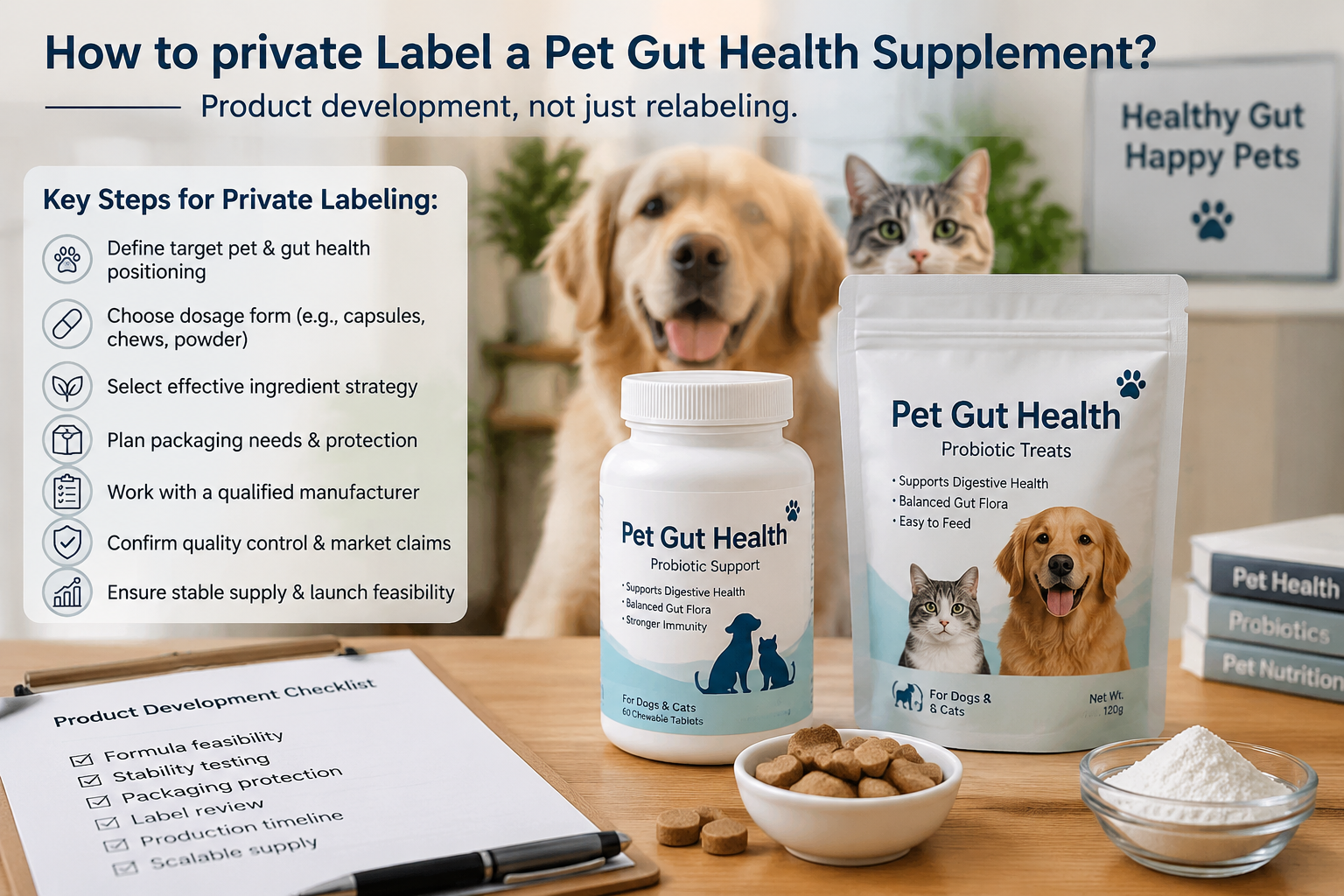
A practical pre-launch decision checklist
I like using a checklist because it turns a vague project into a clear launch plan. Brand owners can adapt the checklist below before contacting a manufacturer or during early consultation.
1. Product concept
- Have I defined the target species: dog, cat, or multi-species?
- Have I defined the target life stage?
- Have I chosen one clear gut health positioning?
- Have I checked competitor products in my sales channel?
- Have I identified my product difference beyond packaging?
2. Formula direction
- Does each ingredient have a clear purpose?
- Does the formula match the dosage form?
- Have I avoided overcrowding the ingredient panel?
- Have I considered taste, texture, and serving size?
- Have I asked how probiotics or enzymes will be protected?
3. Dosage form
- Is the format easy for pet owners to use?
- Will pets accept the flavor and texture?
- Does the format support the intended active ingredients?
- Does the production process fit sensitive ingredients?
- Does the format match my price point and sales channel?
4. Packaging
- Does the packaging protect moisture-sensitive ingredients?
- Does it support daily consumer use?
- Is the pack size realistic for serving count and shelf life?
- Do I need sachets, desiccants, foil pouches, jars, tubes, or bottles?
- Does the packaging match shipping and retail needs?
5. Claims and label
- Are my claims appropriate for the target market?
- Have I avoided unverified treatment claims?
- Do the serving directions match the formula?
- Does the label reflect actual ingredient levels and specifications?
- Do I need local regulatory or legal review?
6. Manufacturing and quality
- Has the manufacturer confirmed feasibility?
- Have I approved a sample that reflects the production direction?
- Are raw material specifications clear?
- What finished product tests are planned?
- How will batch traceability be managed?
7. Commercial planning
- What is the MOQ?
- What is the sampling timeline?
- What is the production lead time?
- What is my landed cost after packaging, freight, and duties?
- How soon should I reorder to avoid stockouts?
Use the checklist before comparing prices
Many brands compare quotes too early. A low price is not useful if the formula is not stable, the packaging is not protective, or the label needs major revision. I would first define the product strategy, then compare manufacturers based on the same project brief.
For example, two quotes may look different because one supplier included better packaging, testing, or ingredient quality. Another quote may look cheaper because it excludes important details. A clear checklist helps the brand compare real value instead of only unit price.
A simple launch planning table
| Launch decision | Why it matters | Confirm before production |
|---|---|---|
| Target pet | Affects serving size, flavor, and claims | Dog, cat, age, weight range |
| Dosage form | Affects cost, acceptance, and stability | Soft chew, powder, tablet, gel |
| Probiotic strategy | Affects formula reliability | Strain, CFU target, shelf-life plan |
| Packaging | Affects protection and user experience | Jar, pouch, sachet, tube, bottle |
| Claims | Affects compliance risk | Market-specific review |
| Testing | Affects quality confidence | Microbiology, active level, safety checks |
| Timeline | Affects launch planning | Sample, artwork, production, shipping |
| Reorder plan | Affects supply continuity | Forecast and lead time buffer |
When this checklist is complete, the conversation with a manufacturer becomes much more productive. The brand can ask better questions, and the supplier can provide more realistic guidance. That is how a private label project moves from idea to scalable product.
Frequently Asked Questions
What is the best ingredient for a pet gut health supplement?
There is no single best ingredient for every product. Probiotics, prebiotics, enzymes, and fiber can all support different positioning directions. I would choose ingredients based on the target pet, dosage form, serving size, stability needs, cost target, and market-appropriate claims.
Is a higher CFU count always better for pet probiotics?
No. A higher CFU count is not automatically better. Brands should also evaluate strain suitability, survival through shelf life, processing conditions, packaging protection, and testing expectations. A realistic and stable probiotic plan is usually more valuable than a large number printed on the label.
Are soft chews or powders better for private label gut health supplements?
Soft chews are convenient and popular with dog owners, while powders offer flexible dosing and may suit multi-ingredient formulas. The better choice depends on palatability, moisture sensitivity, ingredient levels, packaging, consumer habits, and target price. I would compare both before deciding.
Can I use the same pet gut health supplement formula in different countries?
You should not assume one formula, label, or claim strategy works everywhere. Ingredient rules, supplement classifications, claim language, and import requirements can differ by market. A manufacturer can support documentation and product review, but market-specific regulatory review is still important.
How long does it take to private label a pet supplement?
Timelines vary by formula complexity, dosage form, packaging, testing, and artwork approval. In many manufacturing projects, sampling and production may take several weeks. At Feelshine Healthcare, typical production lead times are often around 20–45 days after key details are confirmed.
Conclusion
A pet gut health supplement is more than a popular formula in new packaging. I would treat it as a full product development project that connects target pet, positioning, dosage form, ingredient stability, packaging, quality control, and market-specific claims. Before launch, use the checklist above to clarify your concept and reduce risk. If you want to develop a private label or custom gut health product, Feelshine Healthcare can help you review formula direction, dosage form options, packaging, and manufacturing feasibility.
[^1]: "Gut Probiotics and Health of Dogs and Cats: Benefits, Applications ... - PMC", https://pmc.ncbi.nlm.nih.gov/articles/PMC10609632/. Pet-owner survey or market-research data identify digestive-health supplements, including probiotic and prebiotic products, as a recognized segment of companion-animal supplement use; this supports the category context but does not prove demand for any specific private-label product. Evidence role: statistic; source type: research. Supports: Evidence that digestive-health products, including probiotics or related supplements, are a recognized and sizable use case in companion-animal supplements.. Scope note: Contextual support only; category-level data may not reflect a specific geography, dosage form, or brand concept. [^2]: "Veterinary Pet Supplements and Nutraceuticals - PMC - NIH", https://pmc.ncbi.nlm.nih.gov/articles/PMC7802882/. Peer-reviewed veterinary administration studies report that dosage form, palatability, and ease of administration influence owner compliance and animal acceptance; this supports the dosage-form tradeoff discussion but does not rank all supplement formats for gut-health products specifically. Evidence role: general_support; source type: paper. Supports: Evidence that palatability, administration route, and dosage form affect pet-owner compliance and acceptance in companion animals.. Scope note: Contextual support; evidence may come from medication-administration studies rather than private-label supplement products. [^3]: "Study of Viability, Storage Stability, and Shelf Life of Probiotic ...", https://pmc.ncbi.nlm.nih.gov/articles/PMC9691296/. Food-microbiology studies show that probiotic survival during processing and storage is affected by water activity, moisture content, heat exposure, and the surrounding product matrix; this supports the formulation-risk rationale for soft chews containing probiotics. Evidence role: mechanism; source type: paper. Supports: Evidence that water activity, moisture, heat, and matrix conditions influence probiotic survival and quality in food or supplement systems.. Scope note: Mechanistic support; many studies use food or feed matrices that may not be identical to commercial pet soft chews. [^4]: "The Production and Delivery of Probiotics: A Review of ... - PMC - NIH", https://pmc.ncbi.nlm.nih.gov/articles/PMC6463069/. Expert consensus guidance on probiotic products emphasizes that declared viable counts should be meaningful at the end of shelf life and interpreted together with strain identity and storage conditions; this supports the need to evaluate CFU targets beyond the production date. Evidence role: expert_consensus; source type: institution. Supports: Expert guidance that probiotic products should maintain viable counts through the end of shelf life and that strain identity and viable count matter.. Scope note: General probiotic guidance; it may not address every pet supplement matrix or jurisdiction-specific labeling rule. [^5]: "A high-throughput and low-waste viability assay for microbes - PMC", https://pmc.ncbi.nlm.nih.gov/articles/PMC10686820/. Standard microbiology references define CFU as colony-forming units, a measure used to estimate the number of viable microbial cells capable of forming colonies under specified culture conditions. Evidence role: definition; source type: education. Supports: The microbiological definition of CFU as colony-forming units used to estimate viable microorganisms.. [^6]: "Gut Probiotics and Health of Dogs and Cats: Benefits, Applications ... - PMC", https://pmc.ncbi.nlm.nih.gov/articles/PMC10609632/. Peer-reviewed reviews of probiotic use in companion animals report that selected strains can affect gastrointestinal microbiota composition and digestive-health outcomes in dogs or cats; effects are strain- and condition-specific. Evidence role: general_support; source type: paper. Supports: Evidence that selected probiotic strains can influence gastrointestinal microbiota or digestive-health markers in dogs or cats.. Scope note: Does not prove that any unspecified strain or finished supplement will produce the same effect. [^7]: "The International Scientific Association for Probiotics and ...", https://pubmed.ncbi.nlm.nih.gov/28611480/. The international consensus definition describes a prebiotic as a substrate selectively utilized by host microorganisms that confers a health benefit, supporting the description of prebiotics as nutritional substrates for beneficial gut microbes. Evidence role: definition; source type: paper. Supports: The accepted definition of prebiotics as substrates selectively used by host microorganisms to confer a health benefit.. [^8]: "Comparative Digestive Physiology - PMC - NIH", https://pmc.ncbi.nlm.nih.gov/articles/PMC4458075/. Animal physiology references describe digestive enzymes as catalysts that hydrolyze dietary macromolecules, including proteins, lipids, and carbohydrates, into absorbable components. Evidence role: mechanism; source type: education. Supports: Digestive enzymes catalyze the breakdown of macronutrients such as proteins, fats, and carbohydrates during digestion.. [^9]: "The Impact of Fiber Source on Digestive Function, Fecal ...", https://pmc.ncbi.nlm.nih.gov/articles/PMC10812474/. Veterinary nutrition studies report that dietary fiber type and inclusion level can affect fecal consistency, stool quality, and gastrointestinal function in companion animals; the effect depends on fiber source, dose, and overall diet. Evidence role: mechanism; source type: paper. Supports: Evidence that dietary fiber type and level can affect fecal consistency, stool quality, transit, or gastrointestinal function in dogs and cats.. Scope note: General nutrition support; it does not establish the efficacy of a specific fiber blend or serving size. [^10]: "Thermostability of Probiotics and Their α-Galactosidases and the Potential ...", https://pmc.ncbi.nlm.nih.gov/articles/PMC3948641/. Food and feed processing literature documents that elevated processing temperatures can reduce probiotic viability and denature enzymes, thereby decreasing functional activity in heat-sensitive ingredients. Evidence role: mechanism; source type: paper. Supports: Evidence that heat can reduce probiotic viability or denature enzymes, lowering biological activity.. Scope note: Mechanistic support; the magnitude of activity loss depends on the ingredient, temperature, exposure time, and product matrix. [^11]: "Animal Food Labeling and Pet Food Claims", https://www.fda.gov/animal-veterinary/animal-foods-feeds/animal-food-labeling-and-pet-food-claims. FDA guidance for animal products distinguishes general animal-food labeling from claims that imply disease treatment, mitigation, or prevention, supporting the need for careful review of gut-health claim language. Evidence role: general_support; source type: government. Supports: Regulatory guidance that animal product claims implying disease treatment, mitigation, or prevention can trigger drug regulatory concerns and should be substantiated and reviewed.. Scope note: Jurisdiction-specific; FDA guidance directly supports U.S. regulatory context and may not determine requirements in other markets. [^12]: "21 CFR Part 507 -- Current Good Manufacturing Practice, Hazard ...", https://www.ecfr.gov/current/title-21/chapter-I/subchapter-E/part-507. U.S. animal-food regulations in 21 CFR Part 507 set current good manufacturing practice requirements for covered animal-food facilities, supporting the relevance of GMP procedures when qualifying a pet supplement manufacturer. Evidence role: general_support; source type: government. Supports: Current good manufacturing practice requirements for animal food facilities and their relevance to manufacturing controls.. Scope note: Jurisdiction-specific and facility-specific; applicability depends on the product classification, manufacturing location, and regulatory exemptions.