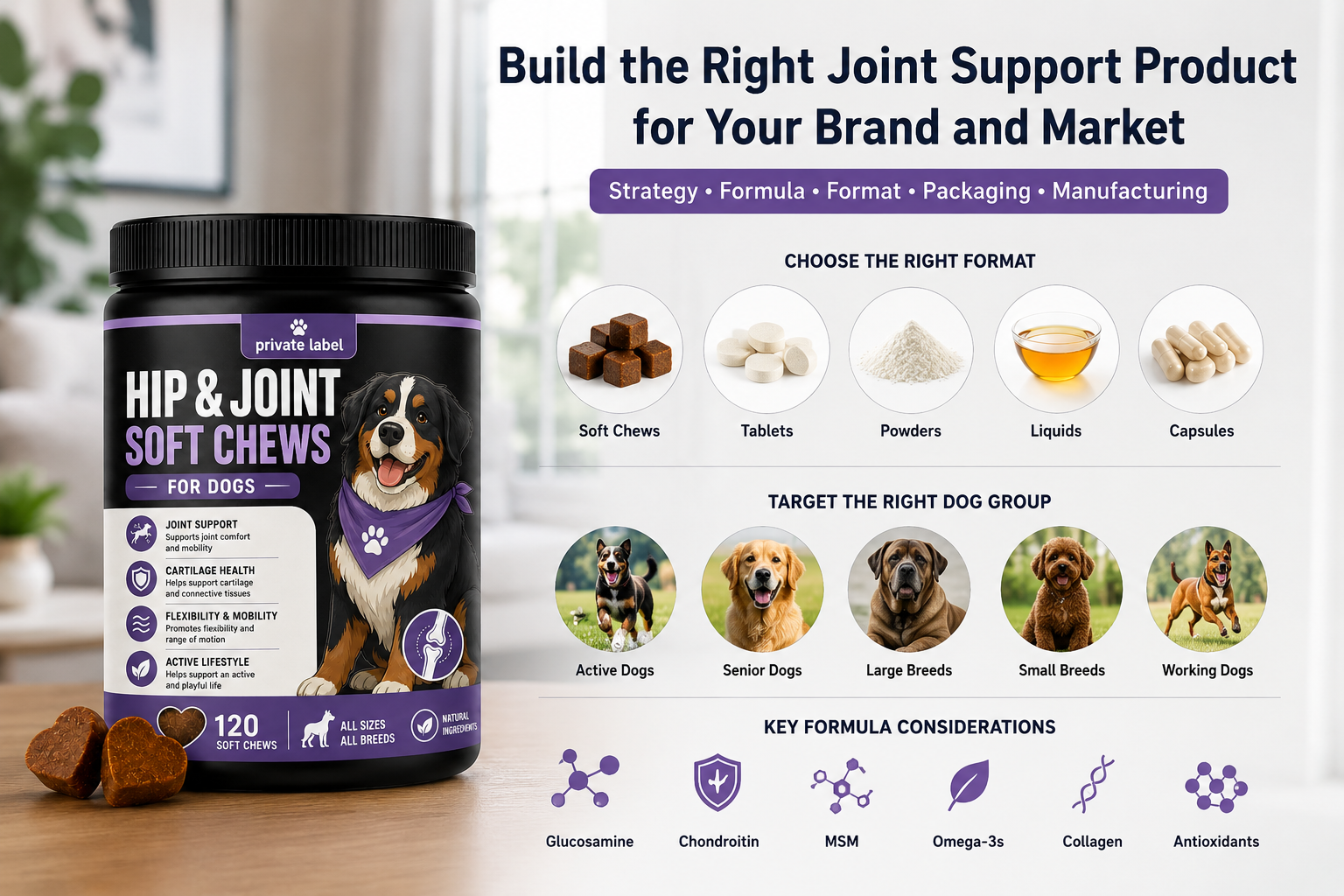
Most first-time brand owners think launching a dog multivitamin starts with finding a factory. It doesn't. It starts with a formulation brief that most people never write.
Creating your own brand of dog multivitamin soft chews requires defining a formulation strategy first—choosing functional pillars, understanding soft chew constraints, designing for your target market's regulations, and then selecting a manufacturer who can translate that strategy into a stable, palatable, production-ready product.
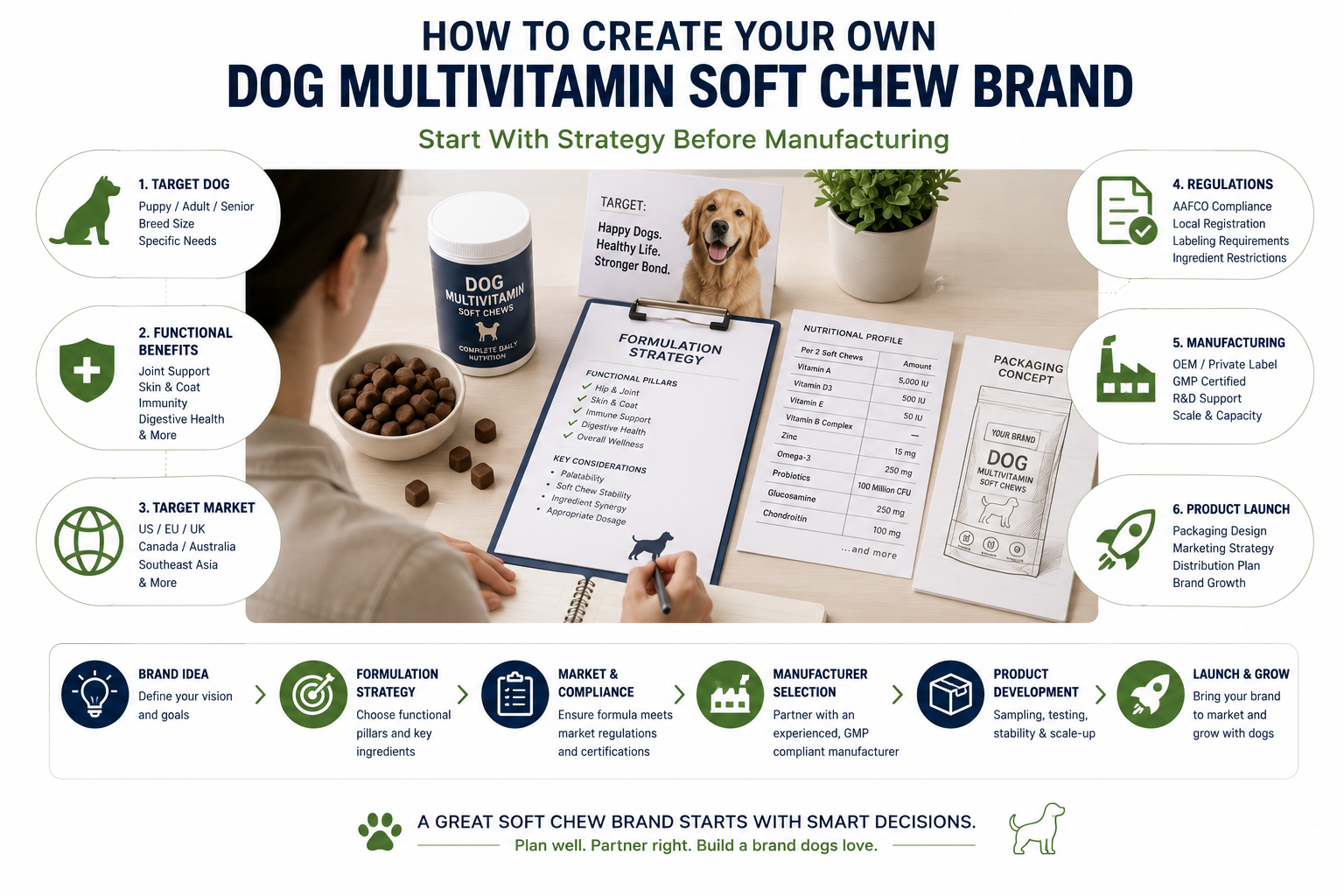
I've spent years developing multivitamin soft chew formulas for startup brands at our GMP-compliant facility. The pattern I see again and again: a new brand owner contacts us with a vague request—"I want a multivitamin soft chew for dogs"—and expects us to hand them a ready-made recipe with their label on it. That's not how this works. There is no universal multivitamin formula. Every project we take on begins with decisions that the brand owner must make before we can even propose an ingredient list. This article walks you through those decisions so you can start your manufacturer conversations informed, not naïve.
Why Is "Multivitamin" Not a Standard Formula You Can Just Pick Off a Shelf?
Many founders assume multivitamins are generic. They're not. Every market, dog demographic, and price point demands a completely different ingredient architecture.
There is no single "multivitamin" recipe in pet supplements. The term covers hundreds of possible combinations of vitamins, minerals, and functional actives—each with different regulatory allowances, cost implications, and stability profiles depending on where you sell and who you sell to.
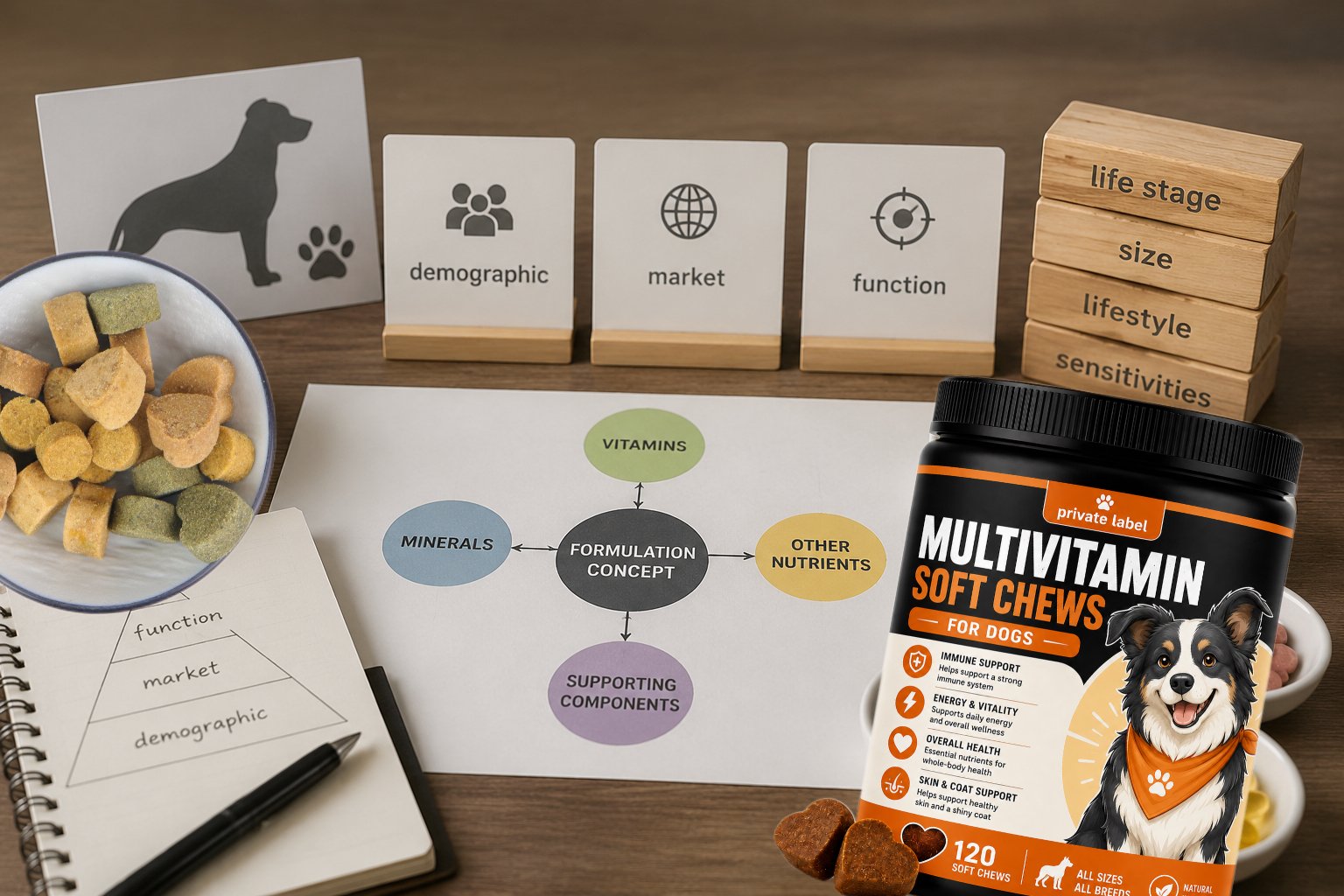
Let me explain what I mean with a concrete example. When a brand owner says "I want a multivitamin for adult dogs," my first questions are never about packaging or price. They are about formulation intent. Here's what I need to know before I can even start sketching an ingredient list:
Key Questions Before Formulation Begins
| Decision Area | Why It Matters |
|---|---|
| Target dog demographic | Puppies, adults, seniors, and large breeds have different nutritional profiles and dosing requirements |
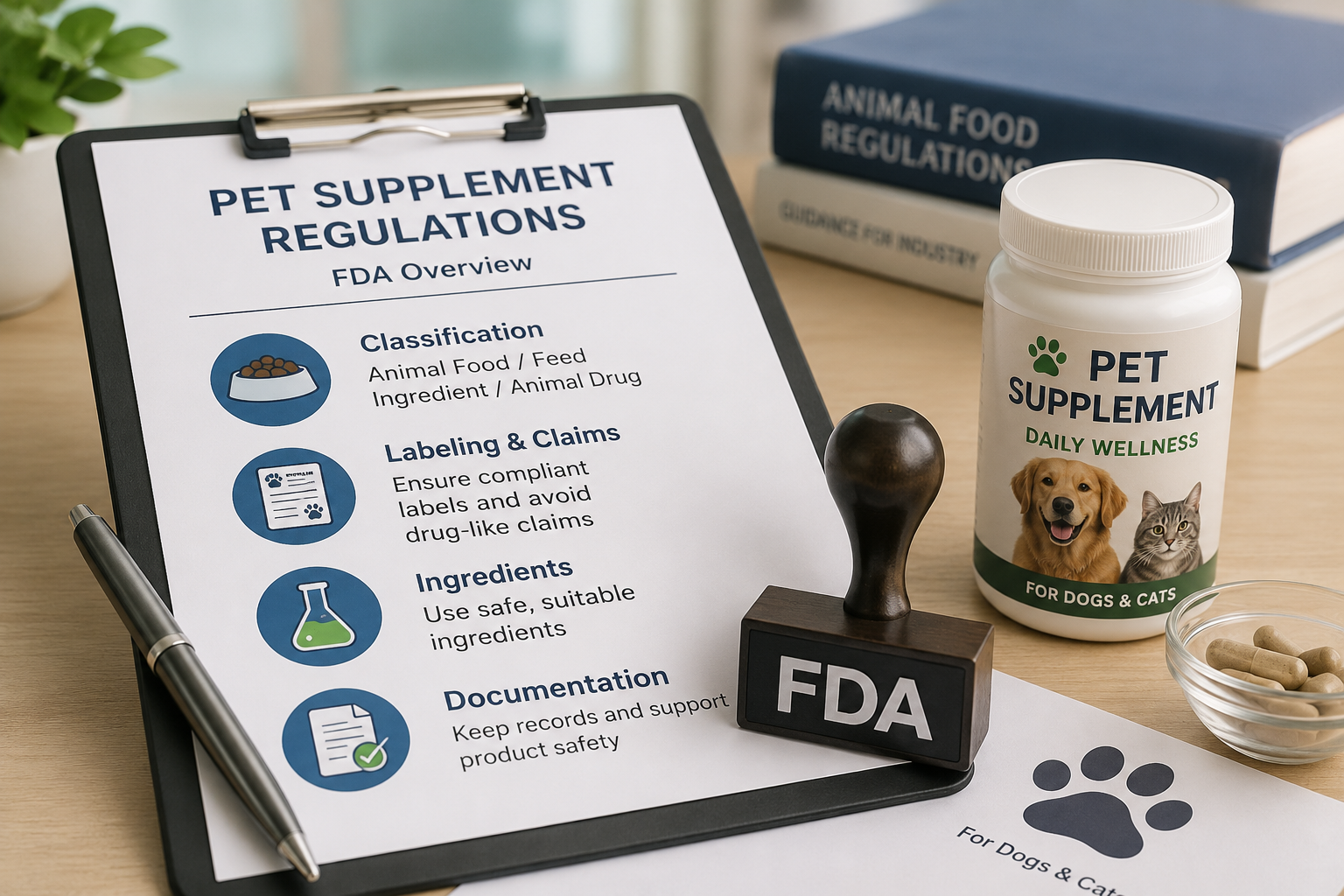
| Destination market | AAFCO guidelines (US), FEDIAF (EU), and APVMA (Australia) have different allowable ingredients and claim structures[^1] |
| Price tier positioning | Premium formulas can use branded ingredients; budget formulas need simpler architectures |
| Functional emphasis | "General wellness" vs. "joint + coat + digestion" lead to fundamentally different formulas |
| Competitive differentiation | What makes your product not identical to 50 others already on Amazon? |
The Formulation Brief Is Your Real First Step
Your first task is not finding a factory. Your first task is writing a formulation brief. This document tells your manufacturer what you want the product to do, who it's for, where it will be sold, and what makes it different. Without this, any manufacturer is just guessing—or worse, giving you a generic formula that won't stand out on shelf.
In projects we've developed for North American brands, the formulation brief typically takes two to three rounds of discussion before it's solid enough to move into R&D. That's normal. Rushing this step is where cost overruns start.
What Makes Soft Chews Different from Tablets or Powders?
Soft chews are not just another delivery format. They impose real manufacturing constraints that change what you can and cannot put in your formula.
Soft chew manufacturing involves heat processing, moisture management, and texture engineering that directly limit which active ingredients survive production intact. Certain vitamins degrade under heat, some minerals alter texture, and palatability requires careful balancing of functional actives against taste masking.
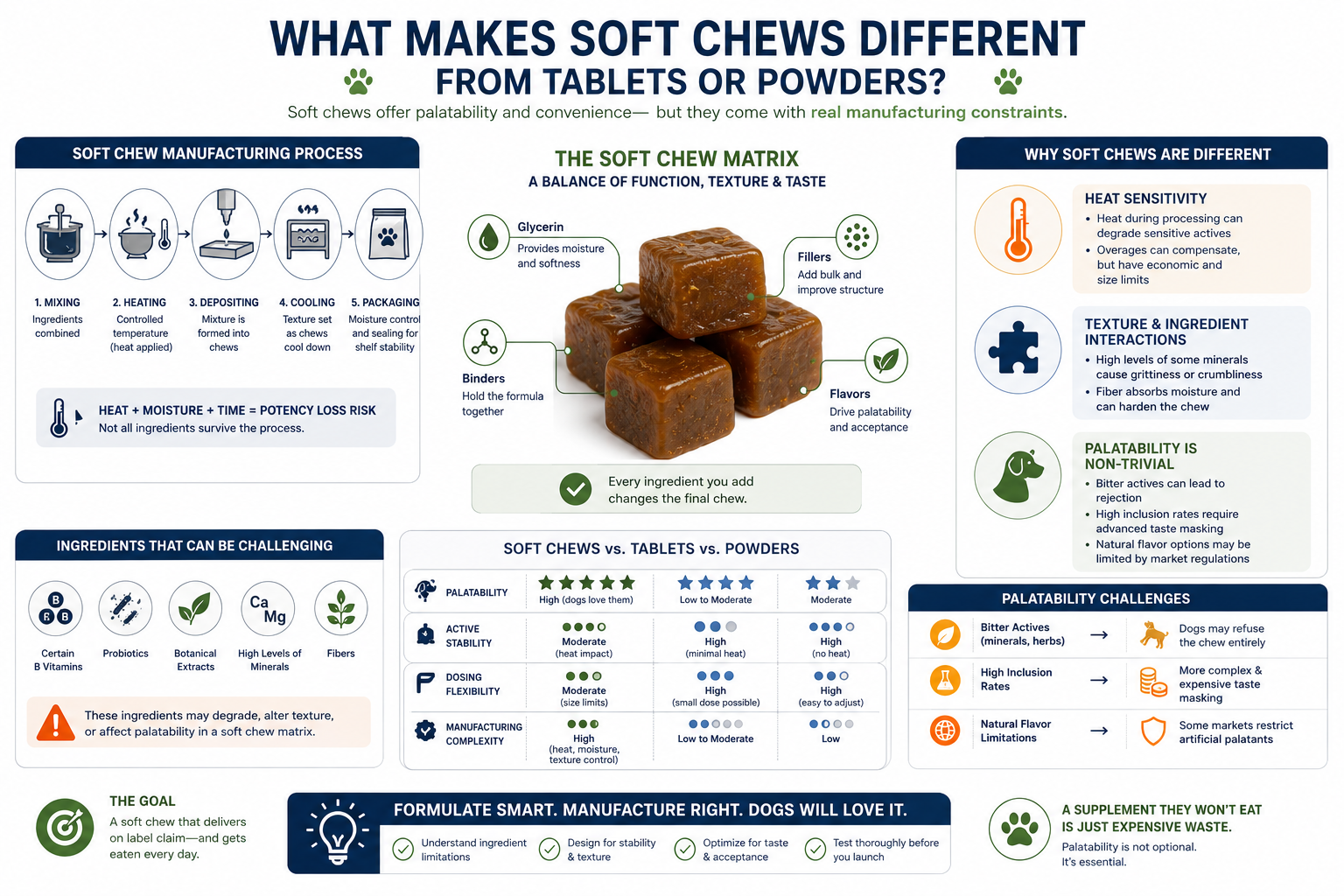
This is a point I push hard with first-time clients. They'll send me a wish list of 15 ingredients they found on competitor labels, and I have to explain why half of them won't work at the levels they want in a soft chew matrix. Here's why:
Heat Sensitivity
Soft chew production typically involves a heating step during mixing and forming. Some B vitamins, probiotics, and certain botanical extracts lose potency when exposed to processing temperatures[^2]. We compensate with overages (adding more than the label claim to account for loss), but there are limits. If an ingredient loses 40% of its potency during processing, the overage needed may make the formula economically unviable[^3] or push the chew size too large for comfortable consumption.
Texture and Ingredient Interactions
Soft chews depend on a careful balance of glycerin, binders, and fillers to achieve the right chewability[^4]. High levels of certain minerals—especially calcium or magnesium—can make the chew gritty or crumbly[^5]. Fiber ingredients can absorb moisture and harden the chew over shelf life[^6]. Every ingredient you add changes the physical properties of the final product.
Palatability Is Non-Trivial
| Challenge | Impact |
|---|---|
| Bitter actives (some minerals, herbs) | Dogs may refuse the chew entirely |
| High inclusion rates | Taste-masking becomes more expensive and complex |
| Natural flavor limitations | Some markets restrict artificial palatants |
A common request we push back on: "Can you add kelp, turmeric, and spirulina at high levels?" Technically yes. But the resulting chew tastes and smells terrible to most dogs. We run palatability assessments for a reason. A supplement that dogs won't eat is not a supplement—it's waste.
How Should You Think About Formula Architecture Instead of Just Listing Ingredients?
Stop thinking about ingredients as a checklist. Start thinking about functional pillars and a differentiation hook.
Effective multivitamin formulas follow a "core efficacy cluster + differentiation hook + label-friendly design" logic. This means choosing 3–4 functional pillars that work together, adding one signature angle that separates you from competitors, and ensuring every ingredient is label-compliant in your target market.
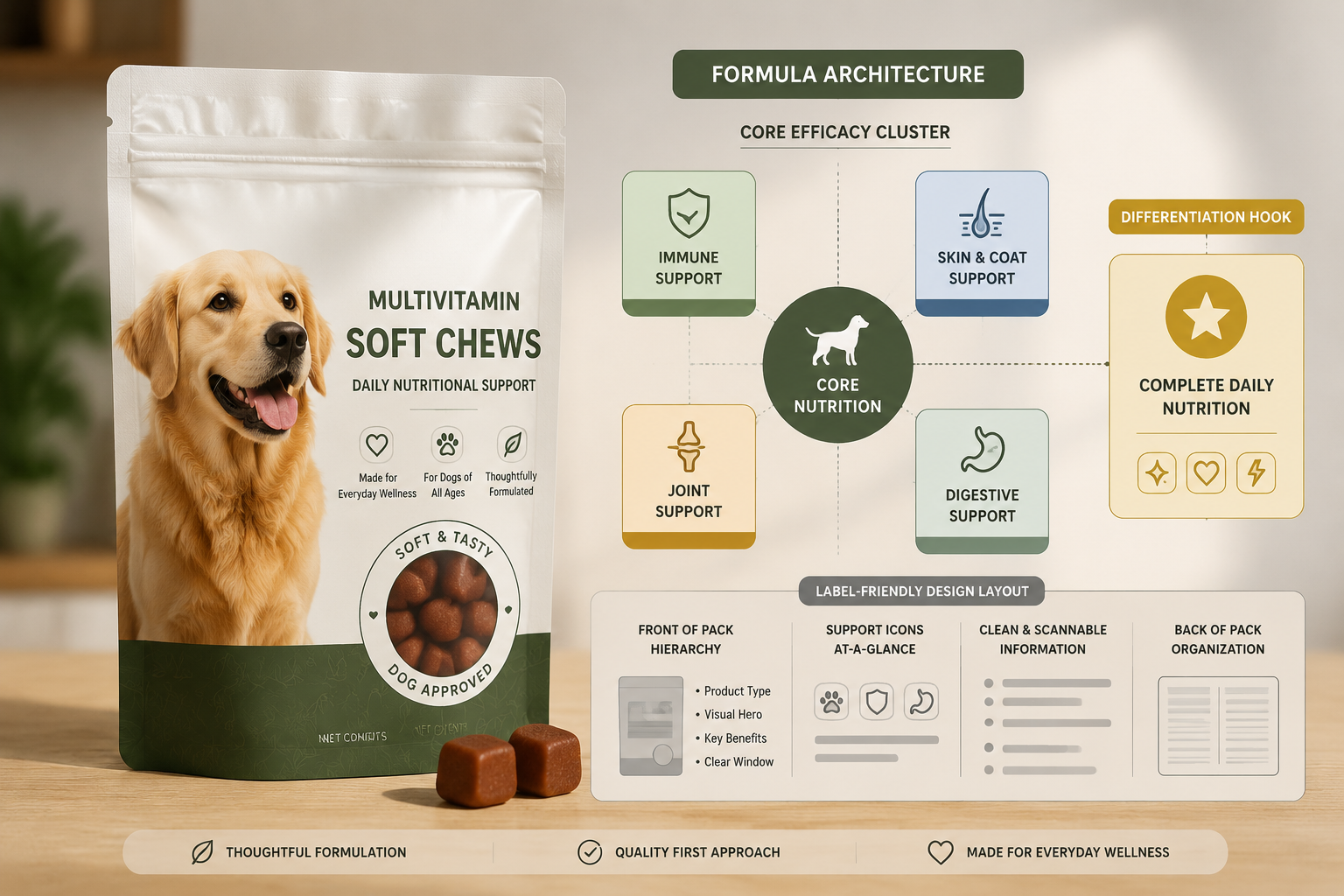
I'll break down what this framework looks like in practice. Most successful multivitamin soft chews we've produced don't try to do everything. They do a few things well and communicate it clearly.
The Core Efficacy Cluster (3–4 Pillars)
Choose three to four functional areas your formula will support. These become the backbone of your product story and your label claims. Common pillar combinations include:
| Pillar Combination | Typical Target Market |
|---|---|
| Joint + Coat + Digestion + Immunity | General adult wellness |
| Growth + Bone + Brain + Energy | Puppy-specific formulas |
| Joint + Heart + Cognitive + Mobility | Senior dog formulas |
| Coat + Skin + Allergy + Gut | Sensitivity-focused positioning |
Each pillar has anchor ingredients that consumers recognize—glucosamine for joints, omega fatty acids for coat, probiotics for digestion, vitamins C and E for immunity[^7]. These give your product immediate credibility.
The Differentiation Hook
This is your one signature angle that makes your product not interchangeable with everything else on the market. It might be a trending ingredient (like a specific mushroom blend or a novel protein source), a format innovation (smaller chew for toy breeds), a sourcing story (sustainably harvested kelp), or a formulation absence (no grain, no soy, no artificial colors).
In my experience, brands that skip this step end up with "me too" products that compete only on price. That's a race to the bottom you don't want to run.
Label-Friendly Design
Every ingredient must pass regulatory scrutiny in your destination market. Some botanicals are approved in the US but not in Europe[^8]. Some claim language that's fine in Australia gets your product flagged in Canada. We check this during formulation development, not after production. Fixing a non-compliant formula after you've manufactured 10,000 units is expensive.
What Does the Real Timeline and Cost Structure Look Like?
Forget the "5 easy steps" guides. The actual development process has more stages—and more surprises—than most founders expect.
A realistic timeline from first formulation discussion to finished goods shipment is typically 3–6 months[^9], not the "few weeks" that many guides suggest. This includes iterative sampling, stability testing, compliance review, packaging development, and production scheduling—each with potential revision loops.
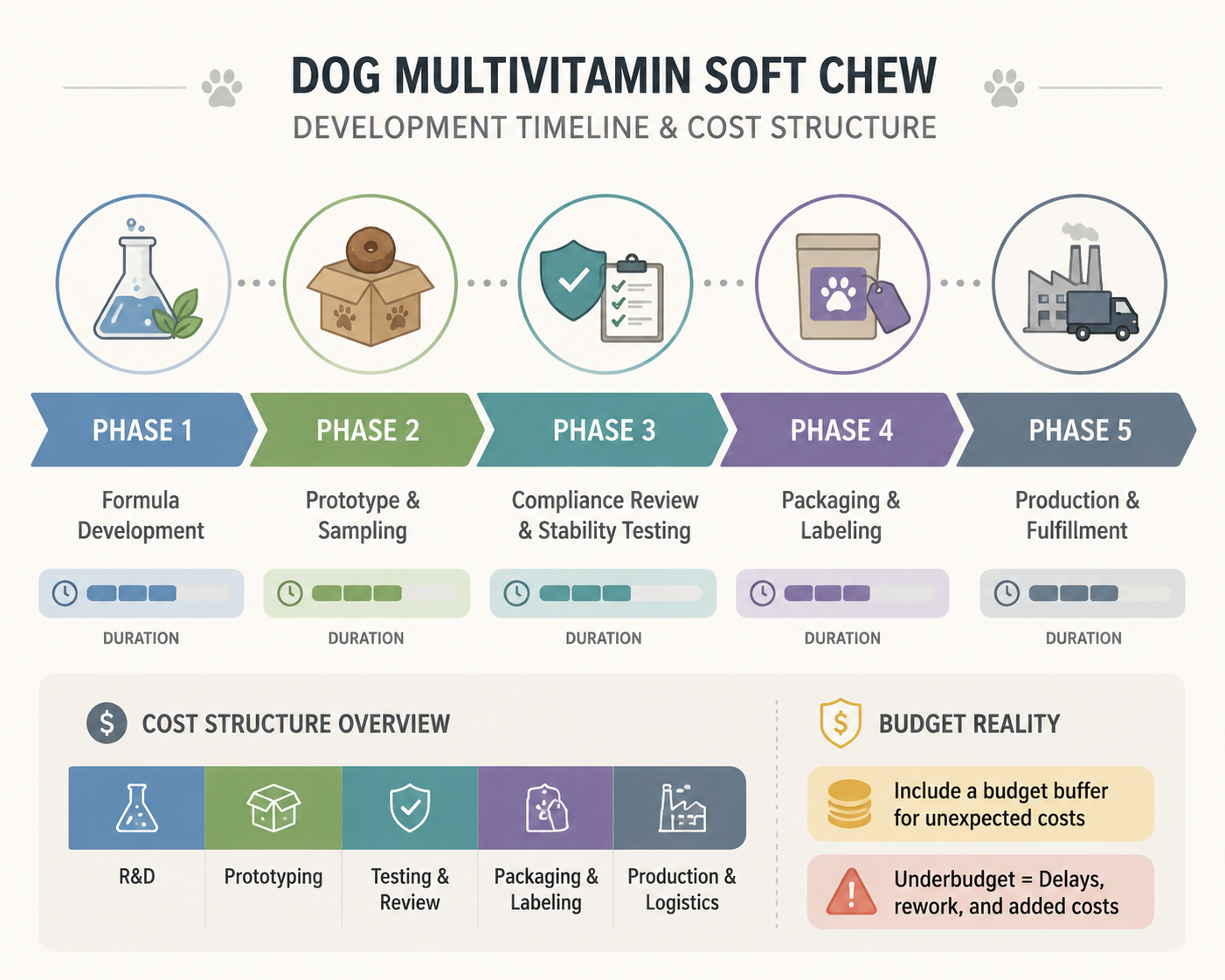
Let me walk through what actually happens after you submit a formulation brief to a manufacturer. This is based on hundreds of projects I've managed from our side of the table.
Phase 1: Formulation Development (2–6 weeks)
Your manufacturer's R&D team reviews your brief and proposes an initial formula. You review it. You request changes. They adjust. This back-and-forth typically takes two to four rounds. Each round takes three to five business days on the manufacturer's side, plus whatever time you need to review.
Phase 2: Sampling and Adjustment (2–4 weeks)
Physical samples are produced. You evaluate appearance, texture, scent, size, and palatability (ideally testing with actual dogs). First samples rarely nail everything. Expect one to three revision rounds. Each physical sample shipment adds transit time if you're overseas from your manufacturer.
Phase 3: Stability and Compliance (2–4 weeks, often parallel)
Accelerated stability testing determines whether your formula holds up over shelf life[^10]. Compliance review checks every ingredient, every claim, and every label element against your target market's regulations. These steps sometimes force formula changes—which loops you back to sampling.
Phase 4: Packaging Development (2–4 weeks)
| Element | Common Surprise |
|---|---|
| Label design | Regulatory text takes more space than expected |
| Pouch/container selection | Size depends on final chew count and chew dimensions |
| Printing proofs | Color matching and text revisions add rounds |
| Barcode and compliance marks | Different markets require different codes |
Phase 5: Production and Shipment (3–6 weeks)
Actual manufacturing typically runs 20–45 days depending on order size and production scheduling. Add shipping time—sea freight from China to North America or Europe adds another 3–5 weeks[^11].
Budget Realities
I won't quote specific unit prices because they depend on too many variables: order quantity, ingredient costs, packaging complexity, and testing requirements. But I will say this: first-time founders consistently underbudget by 30–50%[^12]. They forget about sampling fees, stability testing costs, regulatory consulting, design work, and shipping. Build buffer into your budget. You will need it.
How Much Does It Cost to Launch a Dog Multivitamin Soft Chew Brand?
One of the first questions new brand owners ask is:
"How much money do I need to launch my own dog vitamin?"
The answer depends on your formula complexity, packaging choice, order quantity, and testing requirements. However, most first-time brands underestimate their launch budget.
Typical Development Expenses
| Cost Category | Typical Range |
|---|---|
| Formula development | $$ |
| Sample revisions | $$ |
| Packaging design | $$ |
| Stability testing | $$ |
| Regulatory review | $$ |
| Initial production | $$$ |
| Freight and import costs | $$ |
Hidden Costs That New Brands Often Miss
- Multiple sample revisions
- Label redesigns
- Registration documentation
- Ingredient substitutions
- Packaging mold fees
- Unexpected shipping increases
The brands that launch most successfully usually budget an additional 20–30% contingency fund for unforeseen expenses.
Stock Formula vs Custom Formula: Which Approach Is Better?
Many first-time brands struggle with this decision.
| Factor | Stock Formula | Custom Formula |
|---|---|---|
| Development Time | Faster | Longer |
| Initial Investment | Lower | Higher |
| Product Differentiation | Low | High |
| Intellectual Property | Limited | Better Protection |
| Competitive Advantage | Weak | Strong |
| Long-Term Brand Value | Lower | Higher |
If your goal is to test the market quickly, a stock formula may be sufficient.
If your goal is to build a premium, long-term pet health brand, custom formulation usually delivers better differentiation and stronger margins.
What Should You Look for in a Manufacturing Partner?
Not all manufacturers can do soft chews well. And not all soft chew manufacturers understand multivitamin formulation complexity.
Look for a manufacturer with demonstrated soft chew expertise, in-house formulation capability, regulatory knowledge for your target market, flexible minimum order quantities, and transparent communication about limitations and timelines. The right partner tells you "no" when your formula won't work—not just "yes" to get your order.
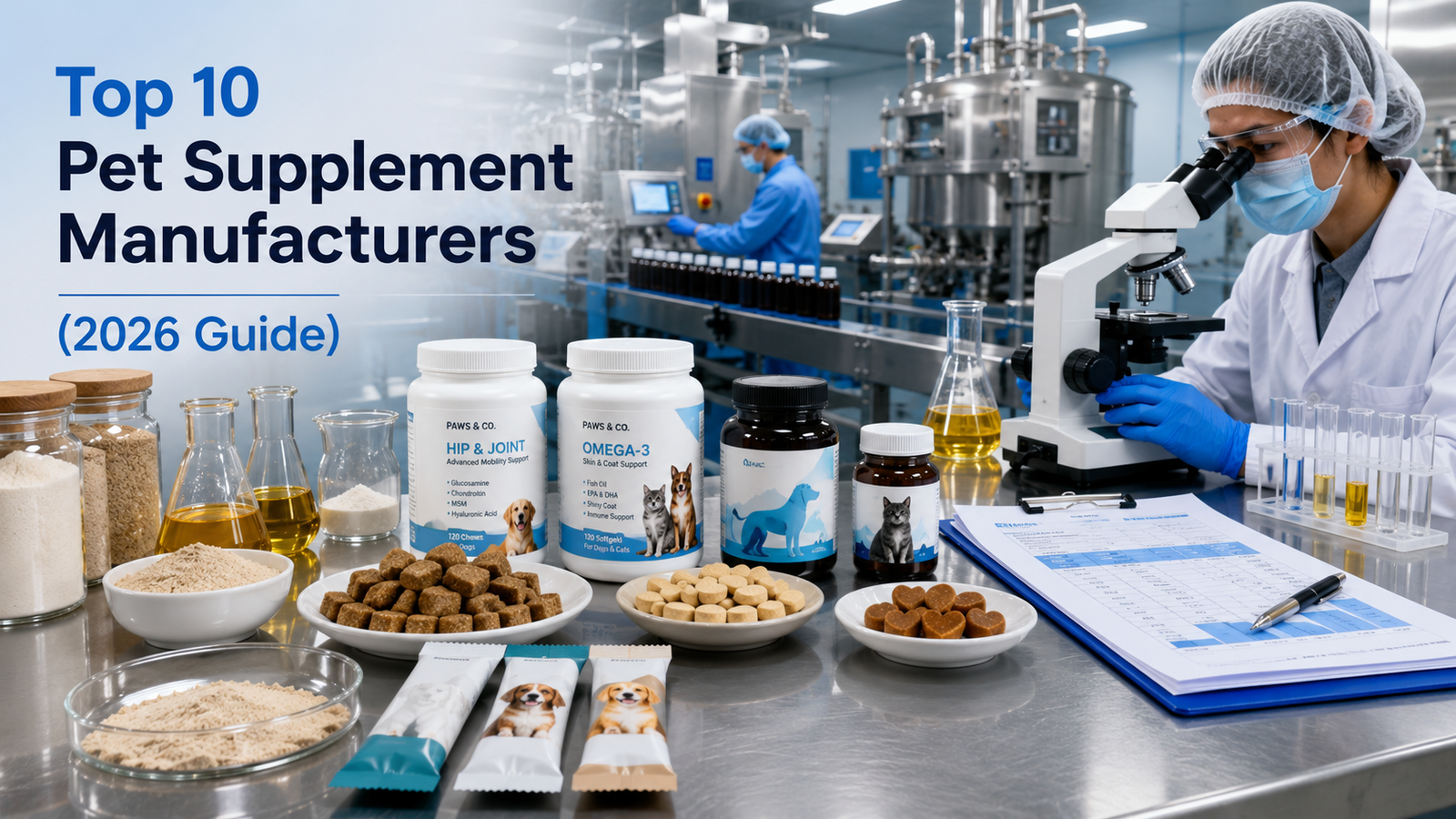
Here's what separates a good manufacturing partner from a merely adequate one, based on what I've seen from both sides of the conversation:
Formulation Capability vs. Just Production
Some factories only produce—they take your exact formula and make it. Others, like our team at Feelshine Healthcare, actively develop formulas with you. For a first-time brand owner who doesn't have a pet nutritionist on staff, formulation support is not optional. It's essential.
Questions a Good Manufacturer Should Ask You
A manufacturer who immediately says "sure, send your formula and we'll quote it" without asking deeper questions is a red flag. Here's what a thorough R&D team should be asking:
| Question Category | What They're Assessing |
|---|---|
| Target market and regulations | Whether the formula will be compliant |
| Dog demographic | Whether dosing and ingredient levels make sense |
| Price positioning | Whether the formula is economically viable at your target retail price |
| Competitive landscape | Whether they can help you differentiate |
| Previous experience | Whether you need more guidance or less |
Soft Chew Specific Expertise
Ask potential manufacturers: How many soft chew SKUs have you produced? What palatability challenges have you solved? What ingredients have you rejected for soft chews and why? Their answers tell you whether they truly understand the format or just list it as a capability.
Transparency About Limitations
The best manufacturers tell you when something won't work. They push back on unrealistic timelines. They flag ingredients that will cause stability problems. They explain why your desired 25-ingredient formula needs to be simplified. This honesty protects your investment. A "yes-man" factory costs you more in the long run through failed batches, reformulations, and compliance problems.
Frequently Asked Questions
What is the minimum order quantity for dog multivitamin soft chews?
Minimum order quantities vary by manufacturer, formula complexity, and packaging format. Most custom projects require larger quantities than stock formulas.
Can I use my own formula?
Yes. Many manufacturers can produce customer-owned formulas, provided the ingredients are compliant and technically feasible.
How long does product development usually take?
A realistic timeline is typically three to six months, including formulation, sampling, packaging, and production.
Can a manufacturer help with packaging design?
Many full-service manufacturers provide packaging guidance, label reviews, and supplier recommendations.
What certifications should I ask for?
Common certifications include:
- GMP
- ISO
- HACCP
- Third-party testing documentation
- Ingredient traceability records
How many ingredients should a dog multivitamin contain?
More ingredients do not automatically create a better product. Successful formulas usually focus on a few clear functional pillars rather than adding ingredients simply to increase label claims.
Why Do Many Pet Brands Choose a Full-Service Manufacturing Partner?
Launching a pet supplement involves much more than manufacturing.
A full-service partner can assist with:
- Formula development
- Ingredient sourcing
- Regulatory review
- Packaging design
- Stability testing
- Production planning
- Logistics coordination
At Feelshine Healthcare, we work with startups and established brands to simplify the entire product development process—from the initial concept to finished goods delivery.
The goal is not simply to manufacture products. The goal is to reduce development risk and help brands bring better products to market faster.
Conclusion
Creating your own dog multivitamin soft chew brand starts long before manufacturing. It begins with a clear formulation strategy, realistic budgeting, and selecting the right development partner.
The most successful pet supplement brands don't simply copy existing products. They build products around clear functional goals, understand manufacturing limitations, and create formulas that genuinely differentiate their brands.
If you're considering launching a private-label dog multivitamin, preparing a detailed formulation brief is one of the most valuable investments you can make.
At Feelshine Healthcare, we help pet brands develop custom formulations, evaluate ingredient feasibility, navigate regulatory requirements, and manufacture premium pet supplements for global markets.
Whether you're launching your first SKU or expanding an existing product line, our team can help you move from concept to commercial production with greater confidence and lower risk.
[^1]: "FDA Enforcement Policy for AAFCO-Defined Animal Feed ...", https://www.fda.gov/media/180441/download. AAFCO's Official Publication defines ingredient definitions and feed terms for animal supplements in the United States, while FEDIAF's Code of Good Labelling Practice governs pet food and supplement claims in Europe, and Australia's APVMA regulates veterinary chemical products including animal dietary supplements under separate legislative frameworks. Evidence role: definition; source type: government. Supports: That AAFCO, FEDIAF, and APVMA each maintain distinct regulatory frameworks for pet supplement ingredients and permissible label claims. Scope note: Each body's scope differs—AAFCO provides model regulations adopted variably by states, FEDIAF is an industry body rather than a government regulator, and APVMA focuses on registered veterinary products rather than all supplements. [^2]: "Health Benefits of Heat-Killed (Tyndallized) Probiotics: An Overview", https://pmc.ncbi.nlm.nih.gov/articles/PMC6566317/. Research on vitamin retention during thermal food processing demonstrates that water-soluble B vitamins, particularly thiamine (B1) and folate, are among the most heat-labile vitamins, with degradation rates increasing significantly above 60–80°C (Ottaway, 1993; Riaz et al., 2009). Evidence role: mechanism; source type: paper. Supports: That B vitamins (particularly thiamine and folic acid) and probiotic organisms experience significant potency loss when subjected to elevated processing temperatures typical of food and supplement manufacturing. Scope note: Degradation rates vary substantially depending on specific processing conditions (time, temperature, moisture, pH), and published data often derive from food matrices rather than soft chew formulations specifically. [^3]: "Impact of Thermal Processing on the Nutrients, Phytochemicals, and ...", https://pmc.ncbi.nlm.nih.gov/articles/PMC9109159/. Industry guidance and analytical studies indicate that heat-sensitive vitamins such as thiamine and ascorbic acid may lose 20–50% of their declared potency during manufacturing processes involving elevated temperatures, requiring manufacturers to add overages of corresponding magnitude to meet label claims through end of shelf life (Dwyer et al., 2014; USP guidelines on dietary supplement stability). Evidence role: statistic; source type: paper. Supports: That certain vitamins and bioactive ingredients can lose 20–50% of their potency during thermal processing steps in supplement manufacturing, necessitating significant overages. Scope note: Exact degradation percentages depend heavily on specific processing parameters, ingredient form, and matrix composition; the 40% figure is within reported ranges but not universal. [^4]: "[PDF] A Novel Acetaminophen Soft-Chew Formulation Produced Via Hot ...", https://egrove.olemiss.edu/cgi/viewcontent.cgi?article=2095&context=etd. Glycerin serves as the primary humectant and plasticizer in soft chew formulations, maintaining water activity below thresholds that prevent microbial growth while providing the pliable texture characteristic of the format; binders and fillers modulate structural integrity and mouthfeel (Hartel et al., 2018, Confectionery Science and Technology). Evidence role: mechanism; source type: paper. Supports: That glycerin functions as a humectant and plasticizer in soft chew matrices, working in concert with binding agents and fillers to control moisture activity, texture, and chewability. Scope note: Most published formulation science addresses human confectionery or nutraceutical products; pet-specific soft chew formulation data is largely proprietary. [^5]: "In Vitro Robotic Chewing Studies of Food Texture Changes During ...", https://pmc.ncbi.nlm.nih.gov/articles/PMC12381518/. Studies on chewable and gummy supplement formulation note that insoluble mineral salts such as calcium carbonate and magnesium oxide, when included at high concentrations, introduce particulate matter that disrupts the homogeneity of the soft matrix, resulting in perceptible grittiness and compromised structural integrity (Burdock & Carabin, 2004). Evidence role: mechanism; source type: paper. Supports: That high mineral salt concentrations in soft or gummy matrices disrupt the gel or glycerin-based structure, leading to textural defects such as grittiness and reduced cohesion. Scope note: Most published formulation studies focus on human supplements; direct peer-reviewed data on pet soft chew mineral interactions may be limited. [^6]: "Moisture and shelf life in sugar confections - PubMed", https://pubmed.ncbi.nlm.nih.gov/20112158/. Food science research demonstrates that dietary fibers with high water-holding capacity can compete with other matrix components for available moisture, leading to moisture redistribution and progressive textural firming in intermediate-moisture food products during storage (Cho & Samuel, 2009; Roos, 2010). Evidence role: mechanism; source type: paper. Supports: That hygroscopic fiber ingredients can redistribute moisture within a soft food matrix over time, leading to textural hardening and reduced palatability. Scope note: Most published studies examine human food products; the specific behavior in pet soft chew formulations may differ based on glycerin content, packaging, and storage conditions. [^7]: "Glucosamine and chondroitin use in canines for osteoarthritis - PMC", https://pmc.ncbi.nlm.nih.gov/articles/PMC5356289/. Veterinary nutritional research supports the use of glucosamine for osteoarthritis management in dogs (McCarthy et al., 2007), omega-3 fatty acids for dermatological health (Bauer, 2011), select probiotic strains for gastrointestinal function (Schmitz & Suchodolski, 2016), and vitamins C and E as antioxidants supporting immune response (NRC, 2006, Nutrient Requirements of Dogs and Cats). Evidence role: expert_consensus; source type: paper. Supports: That glucosamine has demonstrated joint-supportive effects in dogs, omega-3 fatty acids improve coat and skin condition, probiotics modulate canine gut health, and vitamins C and E contribute to immune function. Scope note: Efficacy varies by dose, form, and individual animal; not all studies demonstrate clinically significant effects at levels typically included in multivitamin supplements. [^8]: "[PDF] Exporting Food Supplements to the European Union EU-28", https://apps.fas.usda.gov/newgainapi/api/report/downloadreportbyfilename?filename=Exporting%20Food%20Supplements%20to%20the%20European%20Union_Brussels%20USEU_EU-28_1-11-2017.pdf. The European Union's Regulation (EC) No 1831/2003 on additives for use in animal nutrition requires pre-market authorization for feed additives including many botanical substances, whereas in the United States, AAFCO's ingredient definitions and FDA's GRAS framework permit a broader range of botanicals without equivalent pre-authorization requirements. Evidence role: general_support; source type: government. Supports: That the EU maintains a more restrictive regulatory framework for botanical ingredients in animal feed and supplements compared to the US, with some botanicals requiring specific authorization under EU feed additive regulations. Scope note: The specific botanicals affected vary and regulatory status changes over time; a comprehensive comparison would require consulting current versions of both the EU Register of Feed Additives and AAFCO's Official Publication. [^9]: "A Comprehensive Review on Nutraceuticals: Therapy Support and ...", https://pmc.ncbi.nlm.nih.gov/articles/PMC9654660/. Industry sources and contract manufacturing organizations indicate that custom dietary supplement development—including formulation, sampling, stability assessment, and initial production—typically spans 12–26 weeks, with timelines extending further for novel formulations or complex regulatory requirements. Evidence role: general_support; source type: other. Supports: That custom supplement product development from formulation through production typically requires 3–6 months or more, consistent with industry norms for contract manufacturing. Scope note: Published timeline data primarily covers human supplement manufacturing; pet supplement timelines may vary based on regulatory pathway and manufacturer capacity, and most data comes from industry sources rather than peer-reviewed literature. [^10]: "Q1A(R2) Stability Testing of New Drug Substances and Products | FDA", https://www.fda.gov/regulatory-information/search-fda-guidance-documents/q1ar2-stability-testing-new-drug-substances-and-products. The International Council for Harmonisation (ICH) Q1A(R2) guideline establishes accelerated stability testing protocols using conditions of 40°C ± 2°C and 75% ± 5% RH for six months to predict product stability over its intended shelf life; these principles are widely applied in dietary supplement and nutraceutical development. Evidence role: definition; source type: institution. Supports: That accelerated stability testing uses elevated temperature and humidity conditions to predict long-term product stability in a compressed timeframe, following established pharmaceutical and supplement industry protocols. Scope note: ICH guidelines were developed for pharmaceutical products; their application to pet supplements is by analogy rather than direct regulatory mandate in most markets. [^11]: "A Breakdown of China to USA Shipping Time - Dimerco", https://dimerco.com/blog-post/a-breakdown-of-china-to-usa-shipping-time/. Major shipping lines report typical ocean transit times of 14–35 days from Chinese ports (e.g., Shanghai, Shenzhen) to major North American West Coast ports, and 25–40 days to Northern European ports, with additional time for customs clearance and inland transport (Freightos Baltic Index; Maersk route schedules). Evidence role: statistic; source type: other. Supports: That ocean freight transit from major Chinese ports to North American or European destinations typically requires 3–5 weeks of sailing time. Scope note: Transit times vary by specific port pair, carrier, routing, and seasonal congestion; the 3–5 week range is a reasonable generalization but does not account for customs processing or last-mile delivery. [^12]: "[PDF] Just-Below Pricing Discourages Consumers to Upgrade - U.OSU", https://u.osu.edu/kim.7333/files/2021/10/Kim-Malkoc-Goodman-2021-JCR.pdf. Research on the planning fallacy and new product development indicates that initial cost estimates for novel projects are systematically optimistic, with actual costs frequently exceeding budgets by 25–50% or more across industries (Kahneman & Tversky, 1979; Cooper, 2001, Winning at New Products). Evidence role: statistic; source type: research. Supports: That new product development projects frequently exceed initial budget estimates by significant margins, consistent with broader research on planning fallacy and startup cost overruns. Scope note: The 30–50% figure cited in the article appears to be based on the author's professional experience rather than a formal study of pet supplement startups specifically; broader NPD research supports the general magnitude but not the precise range for this niche.